International Divers Union (IDU) announces the publication of its first comprehensive interactive cave diving textbook — a free digital training resource covering the complete IDU overhead environment curriculum, from introductory cavern theory through advanced navigation, accident analysis, equipment configuration, and expedition-level techniques.
The textbook, titled Cave Diver IDU, has been developed as a structured companion to the IDU cave diving programme and is now available online at nolimitworld.ru/cave-diver-idu. The resource is currently published in Russian, with English and German translations actively in preparation and expected to follow in the near future.
The course material was authored by three IDU instructors with extensive cave diving and technical diving experience: Vladimir Polyakov, Evgeny Runkov, and Tatyana Chernova. All photographic content throughout the textbook was contributed by underwater photographer Andrey Gorbunov.
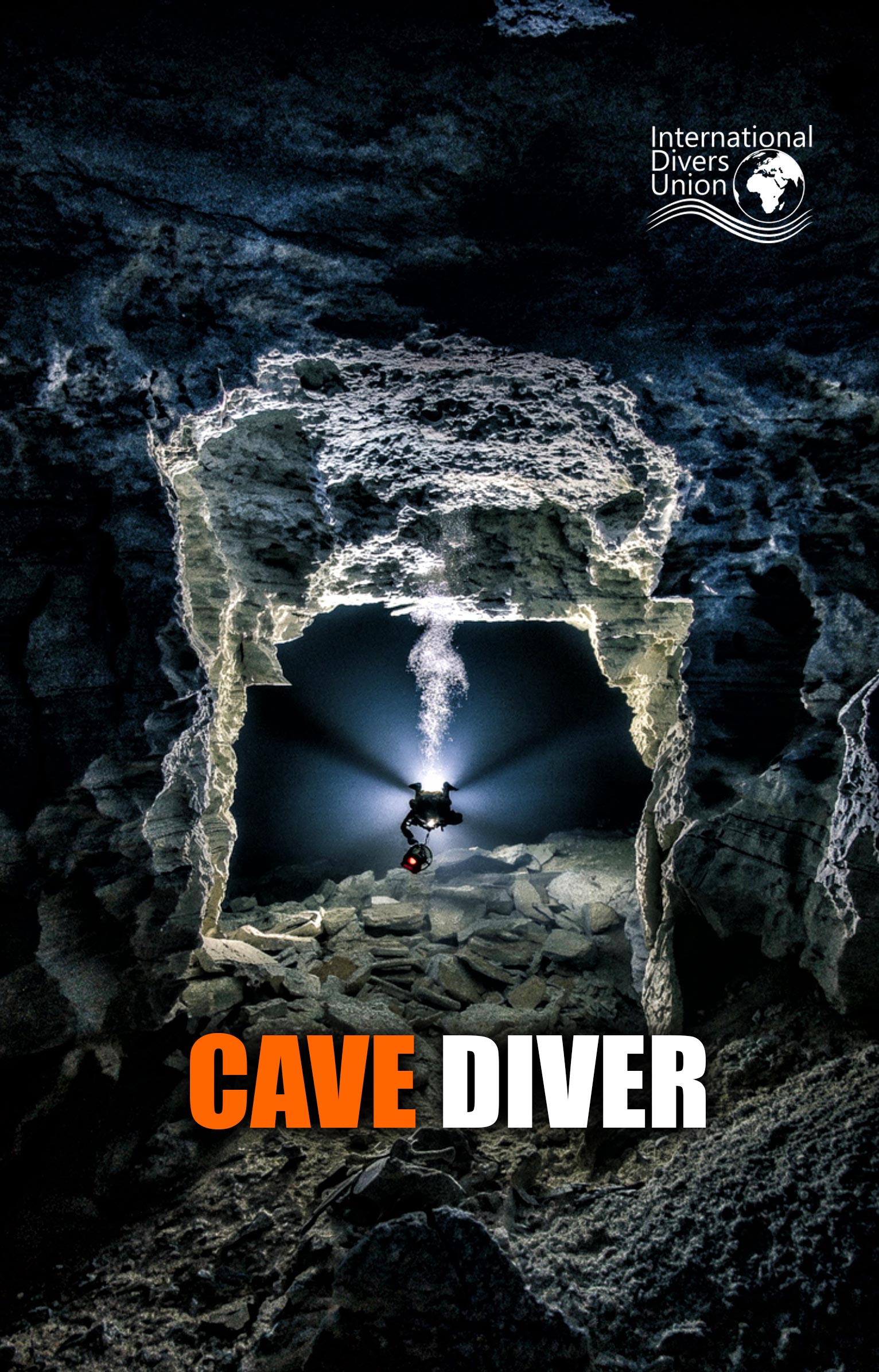
Cave diving occupies a unique position within technical diving — it is an environment where there is no direct access to the surface, where visibility can vanish in seconds, and where the margin for error is measured in breaths, not minutes. The discipline demands not just skill, but a systematic understanding of risk, equipment, navigation, and team dynamics. This textbook was written to deliver precisely that understanding.
Interactive Learning
with Quiz-Gated Progression
Unlike traditional training manuals that present material as a continuous block of text, the IDU Cave Diver textbook enforces a fundamentally different approach to learning. Each of the ten chapters concludes with an integrated quiz — a set of questions directly testing the student's comprehension of the material just covered. Access to the next chapter is locked until all quiz questions are answered correctly.
This design eliminates a pattern that has historically contributed to preventable cave diving accidents: students skipping ahead to topics they find exciting while leaving critical gaps in foundational knowledge. In an overhead environment, a gap in understanding is not an inconvenience — it is a potential fatality. The textbook's progression mirrors the discipline itself: methodical, sequential, and built on verified understanding at every stage.
The IDU Cave Diver textbook is available now at nolimitworld.ru/cave-diver-idu — free, interactive, and accessible from any device with a browser. Currently available in Russian; English and German editions are coming soon.
Ten Chapters.
One Discipline.
The textbook is structured around the core competencies required for safe overhead environment diving, progressing from foundational principles to advanced operational knowledge:
- Introduction to Cave Diving — the overhead environment as a concept, candidate requirements, the four pillars of safety, and the principle of absolute diver self-sufficiency.
- IDU Course Structure — the full training pathway from CAVERN through CAVE-1, CAVE-2, and TECH CAVE, including prerequisites, depth limits, gas rules, and post-certification privileges at each level.
- The Five Rules of Cave Diving — proper training, continuous guideline, adequate gas reserves, staying within the limits of one's certification, and carrying appropriate equipment.
- Cave Environment and Risk Assessment — karst geology, haloclines and thermoclines, cave biology, troglobiontic fauna, and regional cave characteristics across Florida, Yucatán, Europe, Russia, and Southeast Asia.
- Accident Analysis — systematic review of real-world fatality patterns, the critical role of the continuous guideline, gas planning failures, narcosis and breathing mix errors, and the distinction between novice and experienced diver incidents.
- Equipment and Configuration — backmount, sidemount, no-mount, and rebreather setups; streamlining principles, hose routing, light placement, reel types, cutting tools, and DPV operations in overhead environments.
- Propulsion Techniques and Communication — frog kick, modified flutter, back kick, helicopter turn, anti-silting technique, hand signals, light signals, and touch-contact protocols for zero-visibility exit scenarios.
- Guideline Work — permanent and temporary lines, primary reel deployment, tie-off methods, marker placement, the prohibition of double guidelines, and line-handling discipline on entry and exit.
- Cave Navigation — mental mapping, directional arrows, intersection management, jumps and gaps, traverses, circuit routes, and complex multi-line navigation in branching systems.
- Gas Planning and Emergency Procedures — the rule of sixths, the rule of thirds, turn pressure calculation, team-based gas management, lost-line search protocols, lost-diver procedures, and zero-visibility exit drills.
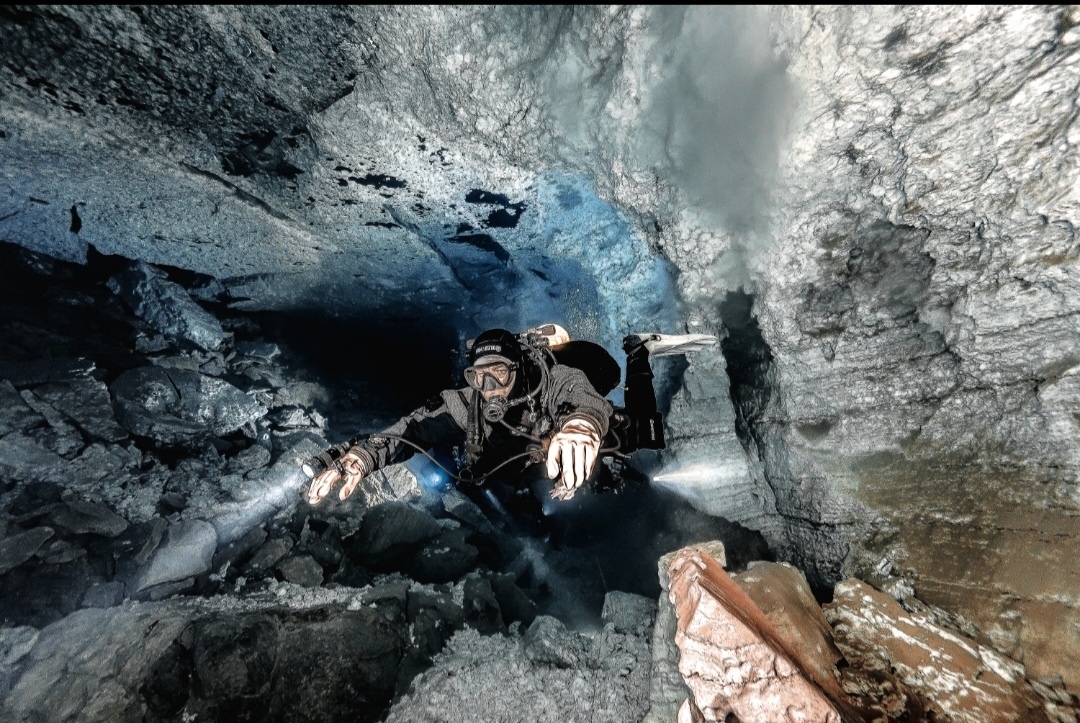
Built on
Real Experience
The textbook opens with a quote attributed to Sheck Exley, the pioneer of modern cave diving safety and author of Basic Cave Diving: A Blueprint for Survival:
The cave itself is not a source of danger. It does not act and does not create threats. Risk arises the moment a diver's behaviour ceases to match the conditions of the overhead environment.
This principle runs through every chapter of the textbook. The authors deliberately avoid presenting cave diving as a collection of isolated skills or spectacular feats. Instead, the material builds a single coherent framework: cave diving as a systematic discipline where every action — from gas calculation to fin technique to marker placement — serves one overarching objective: guaranteed safe return.
The accident analysis chapter draws on decades of real-world incident data to demonstrate a consistent finding: the overwhelming majority of cave diving fatalities result not from unpredictable environmental factors, but from violation of well-known, long-established principles. The textbook makes these patterns explicit, ensuring that students understand not just what the rules are, but why each one exists and what happens when it is broken.
The IDU Cave Diver textbook is a theoretical training resource and does not replace practical instruction or certification. Overhead environment diving requires hands-on training under the direct supervision of a qualified cave diving instructor. The textbook is designed for use in conjunction with IDU's CAVERN, CAVE-1, CAVE-2, and TECH CAVE practical training programmes.
Coming Soon:
English & German
The current edition of the textbook is available exclusively in Russian. Translation into English and German is underway, with both editions expected to become available in the coming months. The translated versions will maintain the same interactive quiz-gated structure, full photographic content, and chapter sequencing.
IDU instructors and dive centres worldwide will be notified when the multilingual editions are published. The textbook will remain freely accessible and require no registration or payment.
The IDU overhead environment training pathway consists of four progressive levels: CAVERN Diver (daylight zone, max 30 m), CAVE-1 Diver (basic cave penetration, max 30 m, no decompression), CAVE-2 Diver (jumps, traverses, circuits, max 40 m), and TECH CAVE Diver (staged penetrations with extended bottom time). Each level builds on the previous one, with no exceptions and no shortcuts.
IDU expresses its sincere hope that this textbook will serve as a valuable resource for current and future cave diving students, for instructors structuring their theoretical programmes, and for certified cave divers seeking to revisit and reinforce the principles that keep them alive underground.
Because in cave diving, the most dangerous thing is not the cave. It is the belief that you already know enough.
Open the Textbook